
What Do You Do After Three Decades at Your Dream Company?
On staying curious, starting over, and what it means to reinvent yourself inside the same company

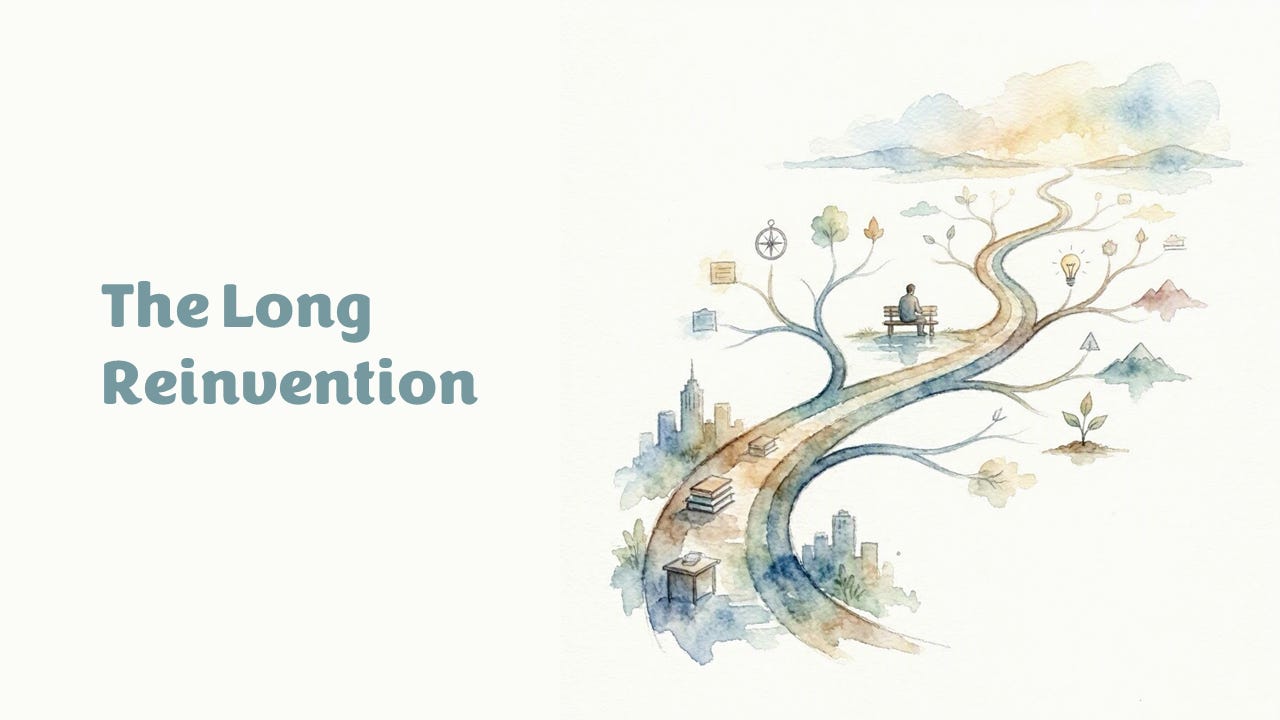
I am writing this as I sit with a decision that weighs heavily on me, one I have been turning over for some time now. I wrote about it more directly here. But before I can think clearly about what comes next, I find myself needing to look back at what came before. Not as a highlight reel, but as an honest account of a career that kept moving, kept changing, and kept asking more of me than the version of myself I arrived with.
Three decades. Six or seven distinct reinventions (that span developer evangelism, program management, sales, strategy, marketing, engineering and more). One company.
The Beginning: A Choice and a Bet on Myself
I was twenty-seven years old when I joined Microsoft, and my eldest daughter had just been born. I needed stability, the kind that could support a growing family, and I had spent the years before that building an unusual combination of credentials for the late 1990s: certified in Lotus Notes as both a developer and an administrator, certified as a Microsoft Solution Developer and Trainer. In 1997, I was shuttling between Boston and Singapore, leading a migration of a Statistical Process Control product from AIX to Solaris for a BBN (Bolt, Beranek and Newman) subsidiary.
Two job offers arrived almost simultaneously. IBM had just acquired Lotus Notes and wanted me on that side. Microsoft wanted me to help compete against Lotus Notes with Exchange. For anyone who knew me then, the decision wasn’t difficult. I had been a fan of Windows, DOS, Visual Basic, Flight Simulator for years. Microsoft was the dream, and I chose it without much hesitation.
What I didn’t know yet was that choosing Microsoft was also the first in a long series of choices to step toward something unfamiliar rather than stay comfortable in what I already knew.
Reinvention One: Learning to Speak Two Languages
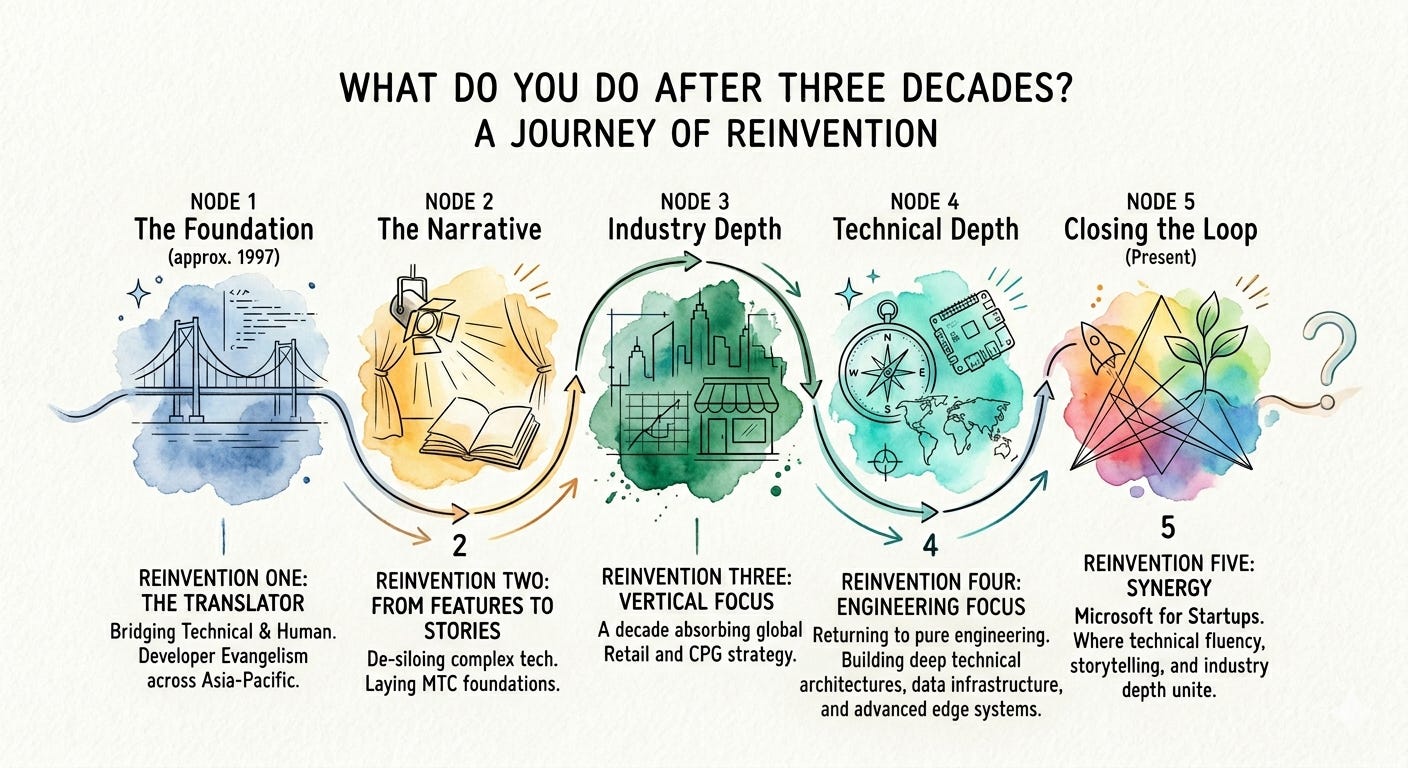
My first role was as part of the inaugural group of Developer Evangelists at Microsoft, working on the Collaboration Data Object library with developers across Asia-Pacific. The work took me through Singapore, Malaysia, Indonesia, the Philippines, Australia, Hong Kong, India. I was building workshop content, writing demos, presenting on stage, and learning at a pace that didn’t leave much room for hesitation.
The skill I was developing, without fully recognizing it at the time, was the ability to move fluidly between the technical and the human. To understand how something was built and also why someone would care. That translation work, between engineering and business, between feature and value, turned out to be the foundation everything else was built on.
The content I developed started reaching teams beyond my region. When the group in Redmond noticed, I was invited to join an internal team called DemosRUS. This was the first real reinvention: from evangelist working a region to someone helping shape how Microsoft told its story to the world.
Reinvention Two: From Features to Stories
DemosRUS was, as far as I know, the first team at Microsoft that deliberately crossed product silos to focus on business outcomes rather than individual features. Our job was to take what each product team was building and reassemble it into something that resembled a real customer problem being solved. We didn’t demo technology. We built narratives around it.
The people on that team were genuinely sharp, and I learned an enormous amount from them. We would spend weeks constructing elaborate end-to-end scenarios, weaving together Microsoft and partner products, and then spend just as long working out how to present it in a way that held an audience. That work taught me something I have carried ever since: that the most important thing you can do with a complex technology is find the human story inside it.
That team evolved into the Microsoft Technology Center program, and helping envision and build the first MTC in Redmond was one of the more satisfying projects of my career. We later helped stand up MTCs in Thailand, Japan, and Singapore. Watching those centers grow and mature over the years, knowing we helped lay the foundations, has been quietly rewarding.
During this period I also won an internal intrapreneurship challenge and was approved to build a company within Microsoft, an idea around conference networking that incorporated social networking site information, formally patented as US20100088372A1. The recession that followed killed it before it could become anything real. Disappointing at the time, though it reinforced something I would come to understand more fully later: that ideas need timing as much as they need merit.
Reinvention Three: Becoming an Industry Person
When the Redmond MTC was wound down, the program had found its real purpose in markets around the world, not at headquarters, I took it as a signal to try something I hadn't done before. Microsoft was rethinking how it went to market, moving from leading with products to leading with industry solutions, and that opened a door to the Retail and Consumer Packaged Goods team. Stepping through it in the mid-2000s meant a reinvention of a kind I hadn't attempted yet: not picking up a new technology but genuinely learning an industry I knew almost nothing about.
The team was an exceptional mix of former retail and CPG operators, vertical specialists, and Microsoft veterans. I was firmly in the last category, and I came in knowing that. I spent the first years absorbing everything I could from the people around me and from the customers themselves. I traveled almost weekly to Fortune 100 retail and CPG companies across the United States, spending long days in stores, distribution centers, and boardrooms. That sustained time in the field, listening to how these businesses actually functioned, was the most concentrated learning of my career.
I joined the Association of Retail Technology Standards during this period and worked collaboratively with retailers and brands on data standards, which gave me a view into how an entire industry organizes itself around shared problems. Over time my focus shifted from field work to global strategy: knowledge management, then business intelligence, then AI for retail and CPG on a worldwide scale. I spoke at NRF Big Show, EuroShop, EuroCIS, and at events in Portugal, Spain, South Africa, the United Kingdom, France. I did road trips across Austria, Portugal, Germany, France, Switzerland, Sweden alongside colleagues, the kind of multi-day travel that builds real understanding of how retail operates differently across cultures. I also was part of a team that built out the first Retail Envisioning Center, which eventually expanded into the Industry Envisioning Center covering all verticals.
More than a decade in retail and CPG transformed me from a technologist who could talk about industry into someone who genuinely understood it from the inside.
Reinvention Four: Following Personal Curiosity into New Territory
After that decade, I made a deliberate choice to follow a personal passion rather than stay in a comfortable lane. Geospatial analytics had interested me for years, and when a role opened on the Azure Maps team focused on growing revenue, I took it. The tools were different, the team was different, and the domain required building new fluency from scratch.
Azure Maps is fundamentally a set of APIs, so I approached it the way I had learned to approach new technology in the DemosRUS years: build things with it, find the real use cases, show what it can do in context. Jupyter Notebooks, QGIS, Postman. The field demos I produced turned out to be some of the more technically satisfying work I had done in years, and the role reconnected me with a hands-on way of working I had missed.
When Bing Maps and Azure Maps merged and my role became redundant, I moved to the Azure IoT team focused on Edge AI. My hobbies for years had included working with ESP32 microcontrollers and Raspberry Pis, so this felt less like a pivot and more like a natural continuation of something I was already doing in my own time. The boundary between personal curiosity and professional work had quietly dissolved.
Reinvention Five: Where Everything Comes Together
My current role on the Microsoft for Startups team is the one that has made me most aware of how each previous chapter was actually building something. Working with early-stage companies on go-to-market strategy requires the full range: deep enough industry knowledge to understand a startup’s customer, deep enough technical fluency to help them translate product capabilities into business value, and enough field experience to know how enterprise decisions actually get made.
The retail and CPG years gave me the industry depth. The DemosRUS and MTC years gave me the ability to find the story inside the technology. The maps and IoT work kept me technically grounded and curious. None of it was wasted. None of it was accidental, even when it felt that way at the time.
The People You Don’t Expect to Meet
Along the way, I met people I could not have imagined encountering when I first walked through the door in 1997. Bill Gates, Steve Ballmer, Satya Nadella within Microsoft. Outside it, people who had shaped entire industries: Mary Dillon, who led Ulta Beauty through one of its most defining periods; Michel-Edouard Leclerc, the public face of E.Leclerc, France’s largest grocery chain; Leena Nair, now Global CEO of CHANEL; Sir Rob Fyfe, former CEO of Air New Zealand; Jensen Huang, who built NVIDIA into what it has become.
Each of those conversations felt significant at the time, like a marker in a long journey. They were real and vivid when they happened. Now they sit in memory the way old photographs do: clear in some places, blurred in others, and slowly shifting with the years. Which is perhaps the most honest thing I can say about what three decades actually feels like from the inside.
Gratitude, Which Feels Inadequate but Necessary
The notable names are easy to remember because they are already known to the world. But the people who shaped me most are the ones whose names you would not recognise: colleagues on the DemosRUS team who taught me how to think about storytelling, teammates in the retail and CPG group who had spent careers in the industry and shared that knowledge generously, the founders and early-stage startups I work with today & the Microsoft for Startups team who have sharpened my thinking in ways I did not expect. Partners and customers across dozens of countries who trusted me enough to let me into their businesses and their problems. I also owe a particular debt to the managers I have had over the years, the ones who saw potential before it was obvious, created space for reinvention rather than demanding consistency, and pushed back with enough honesty to make the feedback useful. Every peer who challenged me when I had it wrong belongs in that same category.
I was never reinventing myself alone. Every evolution I went through was made possible by people who invested time in me, challenged me, collaborated with me, or simply showed up and did excellent work alongside me. That includes the colleagues inside Microsoft across every team I was part of, and the customers, partners, and industry peers I met through Microsoft over the years. The learning I carry from three decades is not really mine. It accumulated through thousands of conversations, shared projects, and the particular generosity of people who didn’t have to help but did.
I am genuinely grateful to all of them. More than I have probably said out loud, and more than a paragraph in a blog post can adequately express.
A Question I Am Still Answering
I would not trade any of it. The colleagues, the customers, the road trips, the demos that came together at the last minute, the projects that didn’t survive the business cycle, the roles I stepped into knowing almost nothing and left knowing far more than I expected. Each reinvention cost something and gave back more.
The question I am sitting with now is whether the instinct that drove all of those reinventions is pointing somewhere new again. Whether the next evolution happens within these walls, or whether it requires a different kind of beginning altogether. I wrote about that more openly here, and I would be glad to hear from anyone who has faced a similar moment and found their way through it.